nacsound news and insights
MetaSound Panels: Acoustic Interfaces for Architecture
Acoustic Metamaterials for Spatial Sound Control
With MetaSound, NACsound® introduces a new class of acoustic panels developed by Francesco Pellisari as a synthesis of scientific research, acoustic engineering, and design culture. MetaSound represents an advanced approach to acoustic treatment, where geometry, rather than mass alone, becomes the primary tool for shaping sound.
From Metamaterials to Sound Geometry
MetaSound is based on the application to acoustics of the concept of metamaterials, originally introduced in the second half of the twentieth century for controlling electromagnetic waves and light. This principle is reinterpreted through Pellisari’s non-coherent wave theory, in which geometry governs sound propagation, diffusion, and spatial interaction.
In MetaSound, form is not decorative—it is functional, acting directly on the behavior of the acoustic wave.
High Performance, Minimal Thickness
The MetaSound panel is capable of generating acoustic scattering comparable to traditional three-dimensional diffusers, while requiring thicknesses up to ten times thinner. At the same time, it provides linear, stable, and highly controlled acoustic absorption.
Compared to commonly used resonant architectural solutions—such as perforated panels or cavity-based systems—MetaSound delivers a more linear and coherent response, free from peaks, coloration, and irregularities. Total construction depth remains below 40 mm, making it suitable for space-sensitive architectural applications.
Redistribution, Not Suppression
MetaSound does not operate through simple subtraction of acoustic energy. Instead, it works through intelligent redistribution of the sound wave. Sound is diffused, controlled, and spatially integrated, preserving naturalness, intelligibility, and timbral quality, while improving overall acoustic comfort.
Materials Tailored to Perception and Context
MetaSound panels can be produced using different materials, selected according to the acoustic, architectural, and perceptual requirements of the space:
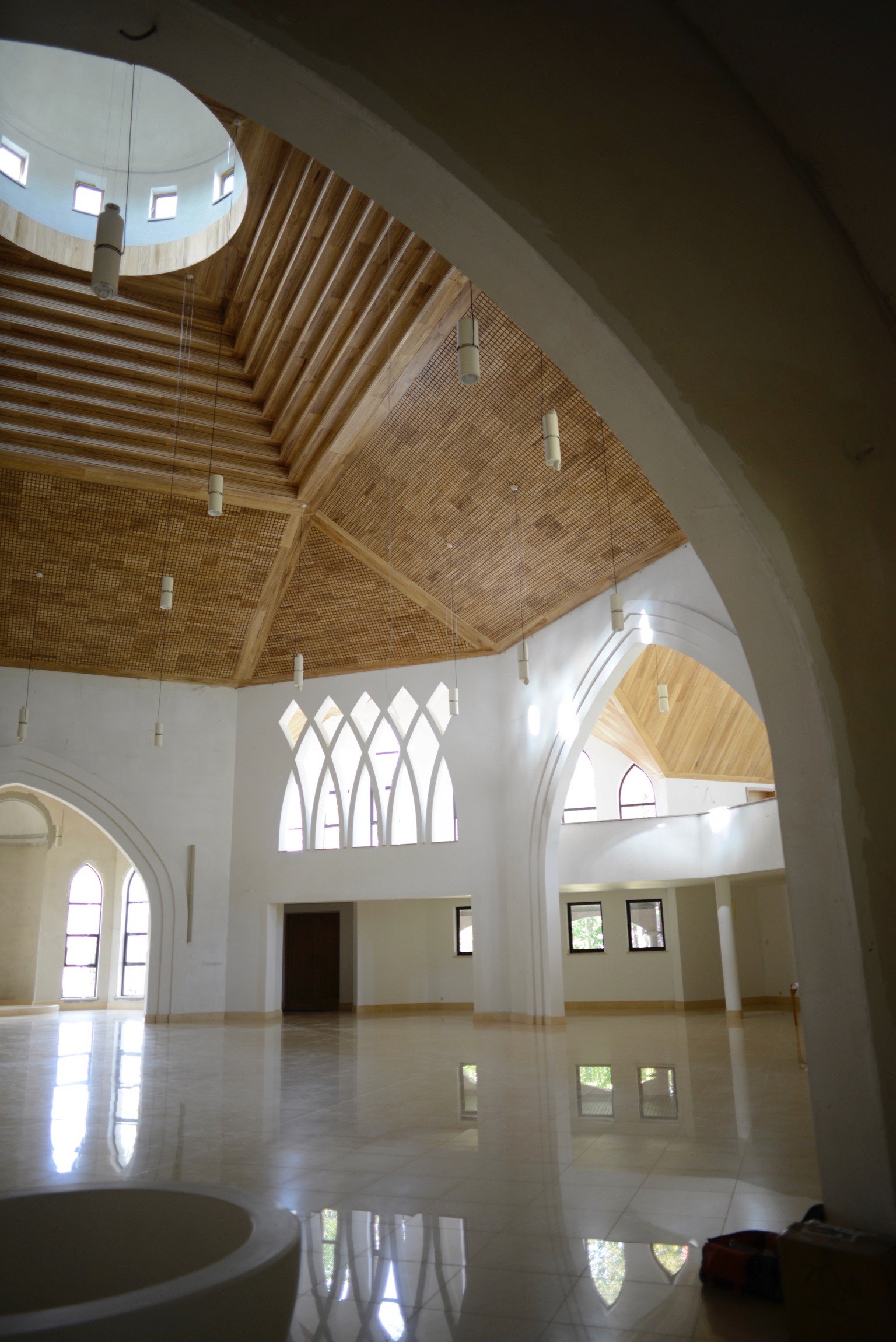
Solid paulownia wood, capable of restoring rich and musical harmonics, ideal for places of worship—such as churches, basilicas, synagogues, mosques — and for auditoriums, where voice and choral sound require depth and natural resonance.
Lightweight, acoustically neutral materials, free from harmonic resonances, suited for restaurants, offices, commercial spaces, and residential environments, where acoustic control must be effective, discreet, and seamlessly integrated.
Solid Surface, for high-profile architectural applications in which the acoustic panel becomes a continuous surface, a design element, and a functional device at once.
An Advanced Acoustic Interface
MetaSound is neither a conventional sound-absorbing panel nor a traditional diffuser.
It is an advanced acoustic interface, conceived for architects, designers, and acoustic engineers who share a common vision:
to integrate sound control into architecture with precision, coherence, and respect for the perceptual quality of space.